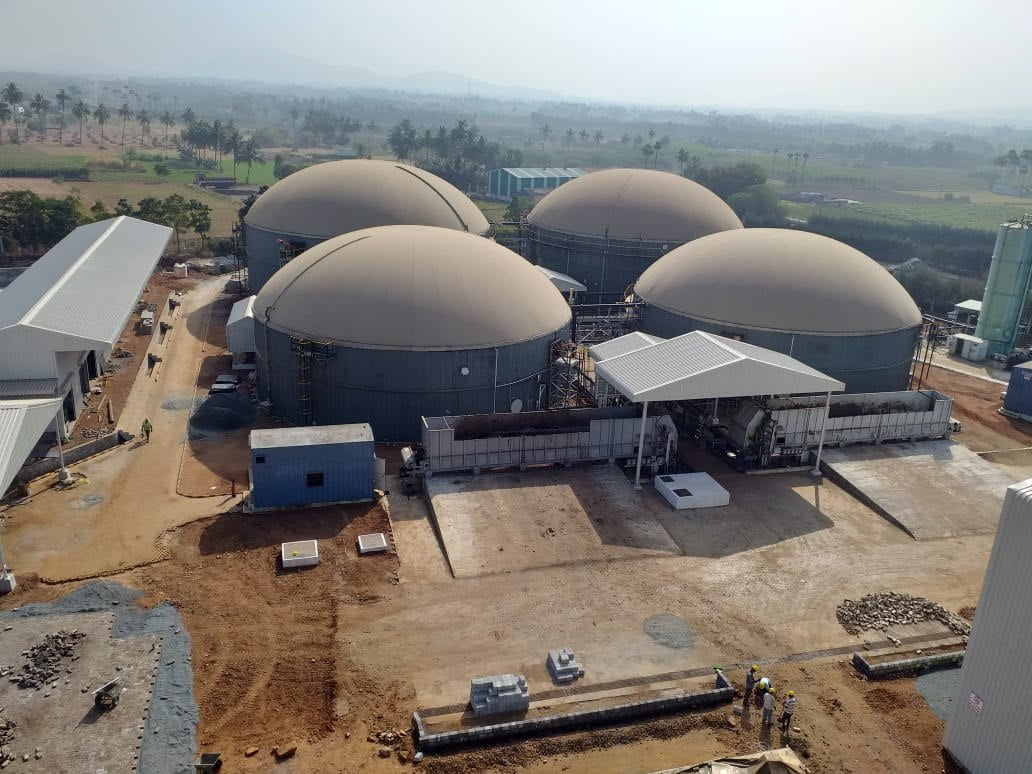
Biogas is a type of biofuel that is naturally produced from the decomposition of organic waste. When organic matter, such as food scraps and animal waste, break down in an anaerobic environment (an environment absent of oxygen) they release a blend of gases, primarily methane and carbon dioxide. Because this decomposition happens in an anaerobic environment, the process of producing biogas is also known as anaerobic digestion.
Anaerobic digestion is a natural form of waste-to-energy that uses the process of fermentation to breakdown organic matter. Animal manure, food scraps, wastewater, and sewage are all examples of organic matter that can produce biogas by anaerobic digestion. Due to the high content of methane in biogas (typically 50-75%) biogas is flammable, and therefore produces a deep blue flame, and can be used as an energy source.
In this process, organic fraction of the wastes is segregated and fed to a closed container (Biogas digester) where, in the presence of methanogen bacteria and under anaerobic conditions, it undergoes bio-degradation producing methane-rich biogas and effluent. Biogas mainly consists of methane (about 60-75%), carbon dioxide (about 25-40%) besides small quantities of N2 and H2S and has a Calorific Value of about 5000 kcal /m3. Depending upon the waste composition, the biogas production ranges from 40-150m3/tone of wastes.
The biogas can be utilized either for cooking / heating applications, or for generating motive power or electricity through dual-fuel, gas engines, low pressure gas turbines or steam turbines.
The sludge from anaerobic digestion, after stabilization, can be used as a soil conditioner, or as manure depending upon its composition, which is determined mainly by the composition of the input waste.